Brief No. 018 · Analysis
Experts Split on Impact of Frontier AI Slowdown for Developing World
Summary
Specialists debating at an event hosted by AIFOD, which publishes this site, questioned whether decelerating frontier AI would aid or harm the Global South.
Disclosure: This story is based on material from AIFOD, the publisher of this site.
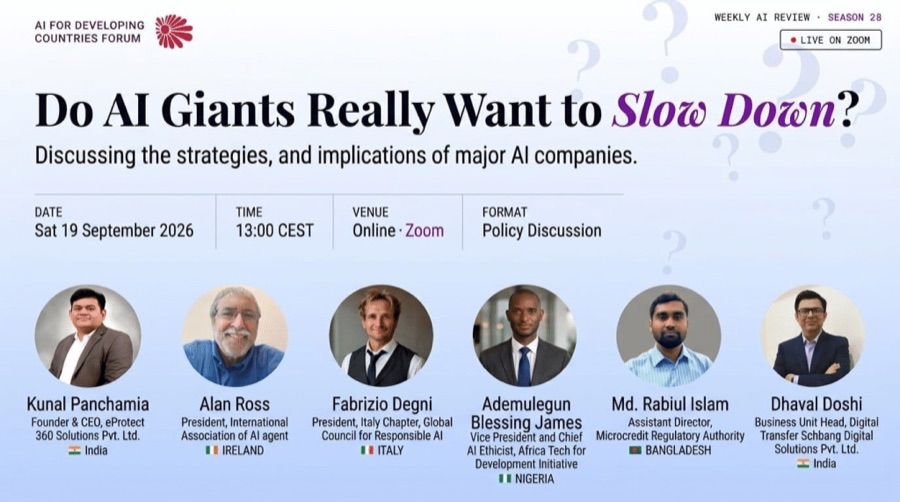
Event report AIFOD Weekly AI Review, Session 28, online, 19 September 2026. Published 4 November 2026.
Specialists from six countries expressed conflicting views on whether moderating the speed of advanced artificial intelligence would assist developing economies, during an online discussion organised by the AI for Developing Countries Forum (AIFOD), which publishes this website.
Several panellists contended that international discussions around pacing fail to reflect local realities in developing nations. Ademulegun Blessing James of Nigeria’s Africa Tech for Development Initiative referenced the African Union’s Continental AI Strategy, arguing that a reduced pace could allow regions time to address shortfalls in digital literacy, financing, and compute. Alan Ross, representing Ireland’s International Association of AI Agents, asserted that the developing world largely does not require frontier systems, noting that United Nations agencies have already catalogued approximately 100 functioning solutions that suffer instead from poor deployment and funding. In Bangladesh, seven out of ten individuals lack digital literacy, according to Md. Rabiul Islam of the country's Microcredit Regulatory Authority.
Market control and governance
Participants also raised concerns that self-imposed slowdowns and standards could consolidate power among established technology firms. Islam observed from microfinance history that incumbent players often back rules to limit emergent competitors, while Kunal Panchamia of India's eProtect 360 Solutions warned against developers designing their own regulatory oversight.
Dissenting from the calls for deceleration, Dhaval Doshi from India’s Schbang Digital Solutions warned that slowing development would fail to assist small enterprises and individuals, while disproportionately burdening smaller actors with compliance costs. Regarding global supervision, speakers noted a lack of clear historic precedents, though Ross suggested international oversight modelled on the International Atomic Energy Agency would have to focus on monitoring physical infrastructure and compute chips rather than software distribution.
How this story was made
This story was rewritten with AI from an article published by AIFOD, linked below.
If you spot a mistake, write to hi@af.net. Read our editorial standards.
References
- af.netAIFOD: Panel at AIFOD Weekly AI Review Splits on Whether Slower AI Development Would Help or Hurt the Global Southhttps://af.net/news/panel-at-aifod-weekly-ai-review-splits-on-whether-slower-ai-development-would-help-or-hurt-the-global-south/